
High School Football: Dysfunction For The Win
Recent changes to the football calendar spotlights ceaseless state and IHSA disorder

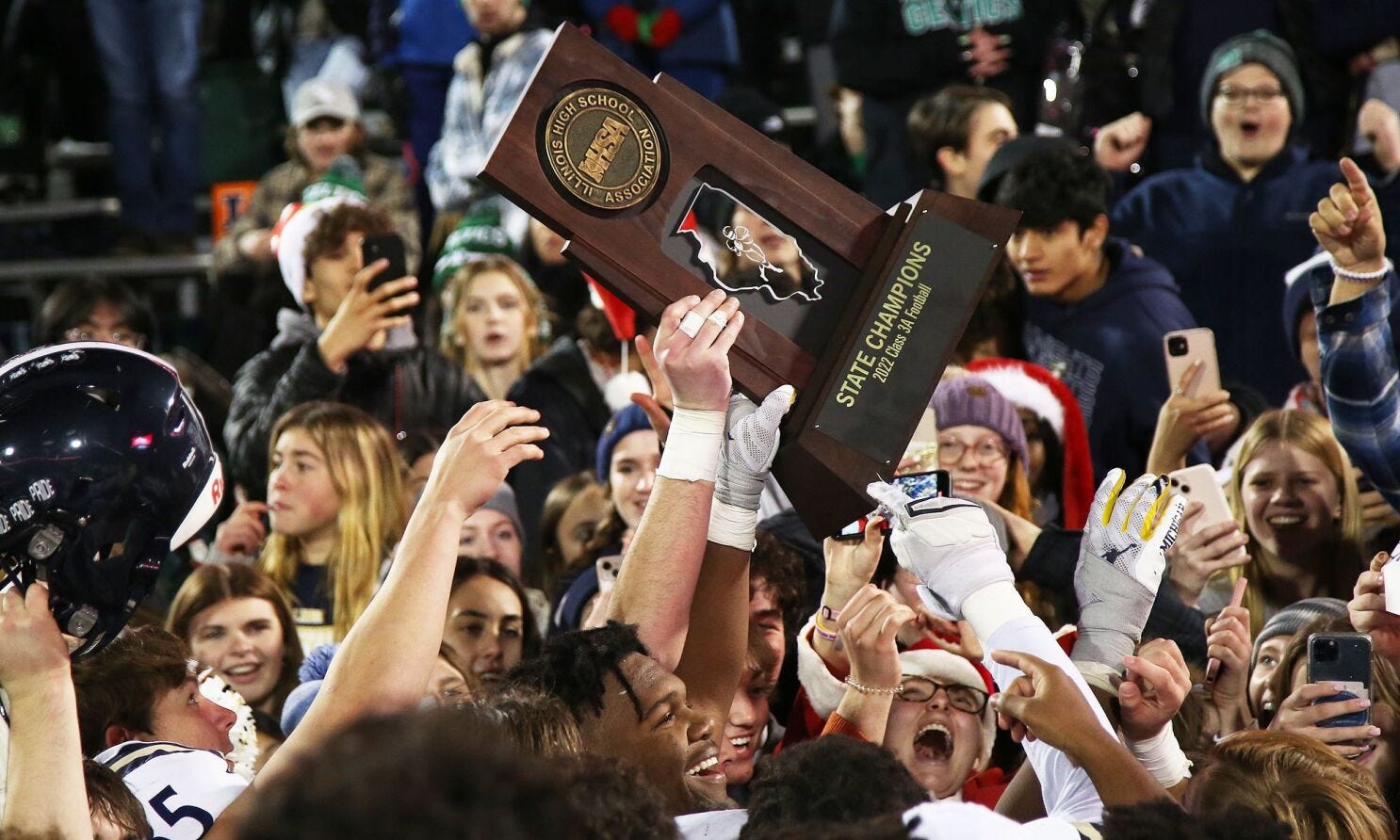
One of the most poignant scenes in the excellent 2006 film “We Are Marshall” comes during a moment of desperation.
Hired after a 1970 plane crash wiped out almost the entire roster and coaching staff of the football Marshall Thundering Herd, the new head coach faced a problem.
Actor Matthew McConaughey portrays head coach Jack Lengyel in the film.
In a preseason meeting, not soon after being hired, Lengyel tells his staff the offensive system isn’t working. In the scene, McConaughey tosses the playbook in a trash can and says, “Men, it is time to simplify.”
For anyone who’s coached or been around coaches, the scene perfectly encapsulates who they are. When the circumstances change, they change with it. They are the Great Adapters (the good ones, at least). One popular creed in the profession is “you’re either coaching it or letting it happen.” Excuses are for losers.
A big change is coming to Illinois high school football this fall that will test the adaptability of coaches and the sport’s most vital workforce, teenage athletes. They will all be just fine. Once again, it’s the administrative management that’s the problem.
I’m burying the lede here, but bear with me. On Friday, Feb. 13, the Illinois High School Association announced the official start date of summer practice for the 2026 season as August 5. This date is a change from the previous August 10 start date. The reason for the date swap is a doozy: in December, IHSA member schools voted to increase the playoff pool by 120 schools (264 to 384), adding a week to the season (14 weeks to 15). Nine regular-season games remain; the playoff tournament will now be six weeks (as opposed to five). Rather than extending the end of the season past the traditional Thanksgiving weekend date, they are moving the start date up. August 21 is this year’s Week 1.
The earlier kickoff date did not safely coexist with the previously scheduled August 10 start to practice, as players need a certain number of practice dates to “acclimate” before a season. All good except for this fact: in the initial December vote to extend the season and change the calendar, those in charge of the proposal either forgot or ignored the potential problem with the limited number of preseason practice dates heading into Week 1. An August 5 start date was not proposed, only August 10.
Which brings us back to last Friday. After the conclusion of a revoting process that took several weeks, member schools elected for an amended start date of August 5.
In a press release, IHSA Executive Director Craig Anderson said:
“Despite the cumbersome nature of the process, I am confident this outcome is in the best interest of student-athlete safety. We recognize that our member schools may bring forward ideas to alter the 2027 football season schedule as a result, and we welcome that. However, given that we are less than six months from the season, we believe this is a positive result that provides scheduling clarity for teams, coaches, and student-athletes ahead of the 2026 season, while prioritizing safety.”
A tell when politicos are covering their butts: overuse of the word “safety.” It’s all about the kids, after all.
In the statement, notice how Anderson acknowledges that playoff expansion and the ensuing calendar adjustment may just be a one-year thing. He welcomes ideas to “alter the 2027 football season.”
Isn’t this just the most Illinois thing ever? To go through a clunky, “cumbersome” process only to reverse it next year?
It’s so on-brand for the IHSA to oversee this latest round of dysfunction.
I attended a coaches’ clinic in early February and ran into a few area high school coaches. Unsurprisingly, none of them is thrilled about the new calendar. In general, people don’t like change, especially regimented football coaches used to the specific cadence and rhythm of an off-season. Rules allow for 20 “contact” dates in June and July, and some programs take those dates primarily in June, others in July. Almost all, though, are done with the summer portions of practices by mid-to-late July and take their vacations before the preseason sequence of practices ramps up in early August.
This new calendar throws a monkey wrench into that schedule.
Common complaints are that vacations will be cut short this summer, athletes won’t be able to get summer jobs, there will not be enough recovery time, etc. All are valid. But athletes, coaches, and parents will adjust. The fact that the parties most impacted by the changes were not consulted is a justifiable reason for frustration.
And that brings us to the rub: the problem is not the change itself. It’s how it was administered.
In theory, playoff expansion can be a good thing. It’s helped boost popularity in college football and the NFL. More bites at the postseason apple, more fan interest. If James Madison and Tulane can compete for a national championship, so can we.
But is that really true? It sounds more like one of those jingoistic, media-driven arguments we’re supposed to accept as fact without evidence. I mean, did you see the scores of the first round CFP games involving JMU and Tulane? Did anybody — even alums of the schools — believe they could win four playoff games?
There is a financial benefit at the college level incongruent with the mission of prep sports. At the high school level, “experience” matters more than revenue. That’s the prevailing argument from the expansion crowd: by opening postseason access, more athletes will want to play, and scheduling (a problem across the state with so much conference realignment) will be easier as teams are not chasing the magic five-win threshold. Coaches can pitch “competing for a championship” as an off-season tagline, and the kids will eat it all up like a bowl of Culver’s frozen custard. On its merits, all defensible arguments.
Prediction: We’re going to see a lot more first and second-round high school football playoff scores this late October similar to the CFP. Like 49-0 at the half. Football at all levels will always be about resources, and “access” doesn’t guarantee competitiveness. The haves will continue to dominate, while the have-nots (many by choice) will struggle to keep up. Will a more motivated middle class emerge, incentivized by access? Maybe, as it would be good for the sport. I just don’t know if the juice for the right to get hammered 62-7 will be worth the squeeze.
In a statement given in December after the initial approval vote to expand the playoffs, Anderson said that the new system “may create some short-term complications for some schools, conferences, and coaches, but we remain optimistic it will create long-term stability in football and beyond.”
The “stability” Anderson hoped for lasted for maybe 30 seconds.
Coaches immediately pushed back, the loudest on the 11 days between the initial start date (August 10) and opening night (August 21). That would not be enough time to acclimate and install, they said. And what’s the point of having a sports medicine advisory committee (they do) if something so “unsafe” gets approved?
All rational concerns. But let’s remember this is Illinois, where the rational is ignored, pragmatism discouraged, tribalness ingrained. Witness the events this week involving the Chicago Bears and plans for a new stadium.
Coaches will adapt, the kids will be alright, but the creators of the chaos remain.
And we’re supposed to accept that’s just all part of the fun.
Have a suggestion for The Kerr Report? Send email to jonjkerr@gmail.com.